Search this Blog

Pageviews

Thursday, August 20, 2009

Water Lily Acoustics


Kavi Alexander's dream label

I met Kavi back in 1992 while in Santa Barbara, California - spent with him a great day... he taught to me a lot: in humanity and humbleness, in proudness and love for traditions (Jelauddin Rumi and much more), in recording techniques, in approaching a recording as a whole, self-producing and following EVERY step of production of a disc - from mike placement, to packaging - and in considering music as an uninterrupted fluid, from Vietnam to India, to South America, to Syria to USA to Europe, where the musicians travels and the WEB and discs gave to music a universal, borders-free status.

Kavi well knows this... his great liner notes where he compares Incredible String Band to Taj Mahal to Ali Akhbar Khan to Hamza el Din to griots from Mali and troubadors in the past, as buskers these days... well, are illuminating.

I own ALL his vinyls and, after he quitted vinyl format (shame on you, Kavi;-))), all his CDs.

My (humble) hint is the following: browse Water Lily Acoustics catalogue and... buy, buy, buy!

Wednesday, August 19, 2009

WJAAS - Western Japanese Audio Appreciation Society - the cartridges survey - Part 6 - Oosawa-san's cartridge and dedicated (active) phono step-up


I received few days ago a small packet from Japan, sent by UPS from my friend Seo... as promised, he sent to me on Oosawa-san's behalf himself, the new active, dedicated phono MC step-up, hand-built with care and passion in a little unassuming, humble aluminium case.

This little box, whose circuitry I already examined and appreciated (also in my limited electronic knowledge...) for the seldom seen solutions, remained - untouched/unused - for a couple days...

When I took my time to link it to my Schick's 12 inchers arm and Ikeda headshell mounting the Oosawa-san's cartridge, I finally understood "why" the japanese artisan strongly hinted me to try the full combo - i.e. cart and step-up!

The balance of the cartrdige was completely, say COMPETELY different from the several other MC-transformers I used: WE 618-B, Verion/Cotter, Peerless 4611, 4685 and 4722.

The inner details and music and weight of the notes had a new relationship... the "blackboard" where the notes were moving was clearer, less "black"... also the hiss in the (very) background of music was more akin to the hiss of my Neumann's mikes on an open-reel recording. Amazing.

Very, VERY quick!

The music was absolutely liquid, ONLY less "fat" than when using also top trannies... not lean or bleached, just a little "slim" vs. trannies sound.

I slightly retuned the mid-low horns and drivers in my autoformers passive 4-ways crossovers and was able to keep the extraordinaire quickness AND to improve the trueness with, say a trio harpsichord, violin and viola da gamba.

While before is sounded a little hifi-sh, after slightly fattening the low-end... a masterpiece!

I guess Oosawa-san uses chamber music and strings for tuning his gears... it's otherwise unbelivable to think he obtained such a refinement.

Not a combo for every kind of music... but with small jazz and ethnic and chamber music, the reality and beauty of the result is simply said, not coming from this planet, period!

Will further investigate in a couple of weeks, when in Japan and having the opportunity to meet my audio/music pals.

Thanks, Oosawa-san: you made something! Music is nearer, now...

Fernanda Pivano passed away yesterday, August 18th


A great, little woman... I met her once, many years ago, at a concert in Milan.
She brought Gregory Corso, Lawrence Ferlinghetti, Jack Kerouak and Spoon River by Edgar Lee Masters in Italy, back in the early '60s

She has been a true catalyst of culture and peace.

I'll miss her a lot...

An interesting, well made list of Super-Discs by Arthur Salvatore


Super Discs: gasoline for your Audio System

I found Arthur's list to be a very tasty, classy mix of (some) TAS' fame HP's listed items, PLUS (a strong point in favour of Arthur's choices) a lot of Harmonia Mundi, Alienor, Telefunken, ECM, Pierre Verany, EMI Reflexe, (my friend Kavi Alexander's) Water Lily Acoustics, etc. down... down... down... to this: BACH-GOLDBERG VARIATIONS-MICHEL KIENER-CERCLE KALLISTOS CK 1004 a Y.B. Andre of YBA - France fame produced and recorded 2-records set of harpsichord solo... I guessed I was the only one to know and cherish this very elusive, limited-edition disc (my copy is 2XX/1000). It's an absolute masterpiece, both musically AND sonically!

A true winner... Arthur knows it and, bravo!, he shares it!

Furthermore, he also quotes some true, semi-unknown masterpieces - i.e. Dom Um Romao-Saudades on Water Lily Acoustics, Collin Walcott's Grazing Dream and CODONA - 2 on ECM... BTW: Hey, Arthur: CODONA - 1 is still better than the 2;-)

Another (little) hint: please buy "The Gil Evans Orchestra plays the music of Jimi Hendrix" on RCA CPL1-0667... dynamics 2die4 and the immortal art of Gil and Jimi: a masterpiece.

Browse in his list(s)... a true goldmine covering all and every musical tastes.

Thanks to Arthur Salvatore for his great job.

Tuesday, August 18, 2009

WEIRDO Award - i.e. The weirdest guitar I ever saw!


More than Shakti/Wechter John McLaughlin's axe, more than Pat Metheny's Picasso Linda Manzer built masterpiece, more than Vishwa Mohan Bhatt's mohan-vina slide guitar...

The WEIRDO Award 2009 goes to Arul's "Combined Percussive Nylon/Steel Strings guitar" from India!

Stop all those silly, random bumping and slapping on our acoustic guitars... now you can precisely choose dumbek or tabla, while strumming sympathetic strings, sitar-like, again choosing nylon OR steel strings.

I'm impressed, fearsome, but sincerely, truly impressed, folks!

Arul's site

Double Bass forever!


Beside being a guitar player since my boyhood (but who inherited an early '900 double bass in early 2000;-)), I've been an hardcore lover and an avid collector of double-bass jazz and classical music for most of my life.

I don't remember EXACTLY when I first heard this mind-boggling sound... maybe, if memory do not fool me, 'twas Charles Mingus' - a 3-records set recorded live...

Later, it was Oregon's "Trios/Solos" on ECM - my first ECM, with the great Glen Moore and his Klotz double-bass which moved me to tears; later, Dave Holland "Emerald Tears" ECM's solo, still in early '70s... and I still remember I listened to this record for 2 times... the third time was having me trying to duet with my first Yamaha 12 strings acoustic, like Ralph Towner with Moore... all the above during the same summer afternoon, of course;-)

At a later date, maybe 15 years ago, I discovered, as it often happens - by chance - a Telefunken disc by Ludwig Streicher playing some Dragonetti and Bottesini duos, with piano accompaniment... and this possibly, blew my mind!

The impressive agility of maestro Streicher, the beauty of overtones and glissandos, the subterrean subbasses sounds coming from this recording opened to a world of unbelivable beauty and deepness.

I soon began collecting double-bass recordings on a sistematic base: record-fairs, first and Robin Wu's ClassiCo from Los Angeles, California, Irvington Music from Portland, Oregon with their paper catalogs proved to be, in pre-WEB times, a source for cheap, great, then sought-after recordings... then came GEMM and Ebay.

Some years later, say in early 2000, I re-counted what I purchased in the years, and to my surprise, I was truly surprised I found more than 60 different recordings.

Now, 2009, owning more than 100+ vinyl-only double bass discs I feel I created something, much more than a cold collection: Rabath, Streicher, Koussevitzky, Karr for classical music and Dave Holland, Gary Peacock, Charlie Haden, Scott La Faro and Barre Philips for jazz are the most famous double-bassists who come to mind, but there are many, MANY great, unknown musicians who recorded very obscure compositions by even more obscure composers... and HERE is the merit of record collecting: not a mere accumulating rare waxes, per se, but learning about music written to the limits of an instrument, music not made for selling... so the most pure of music.

Like Bert Jansch, not a double-bassist, of course, but a GREAT musician, said: "If you sell your music, you sell your soul; if you give your music, you buy your freedom!".

Applicable or not to double bass, it's utterly true.

"..............." (Will fill here a personal double bass music discography soon).

In the meantime, please have a look to my double bass shop of choice:

Double bass 2die4

Monday, August 17, 2009

Harp-guitar world


Harp guitars world

A truly informative, great site, 120 percent devoted to this behemoth of an instrument... from Pasquale Taraffo early virtuosity to Michael Hedges, Beppe Gambetta, Stephen Bennett and Muriel Anderson's... browse among the several plies of this superb site.

A must!

Saturday, August 15, 2009

Paul Kinny's Stereo Acoustic Guitar... from Downunder (N.S.W. - Australia)


... directly from Mars (look at the weird busking Kinny's axe...), these instruments which reminds a Dyer '20s harp guitar, are based on acoustics and the choice to please the player first and the microphone(s) in the studio...

Stereo acoustic guitar video

Kinny Guitars site

Maybe just a tad bright-sounding, but intriguing!

The Mighty Power of Textured record covers


This morning, while lazily listening to Dave Evans' "Sad Pig Dance", I was lovingly handling the 1974 record cover, reading the liner notes and looking at the artwork and pix on the the rear cover while the beautiful notes fluently spreaded in my room in Gotorama and... I wasn't able to stop a teardrop.

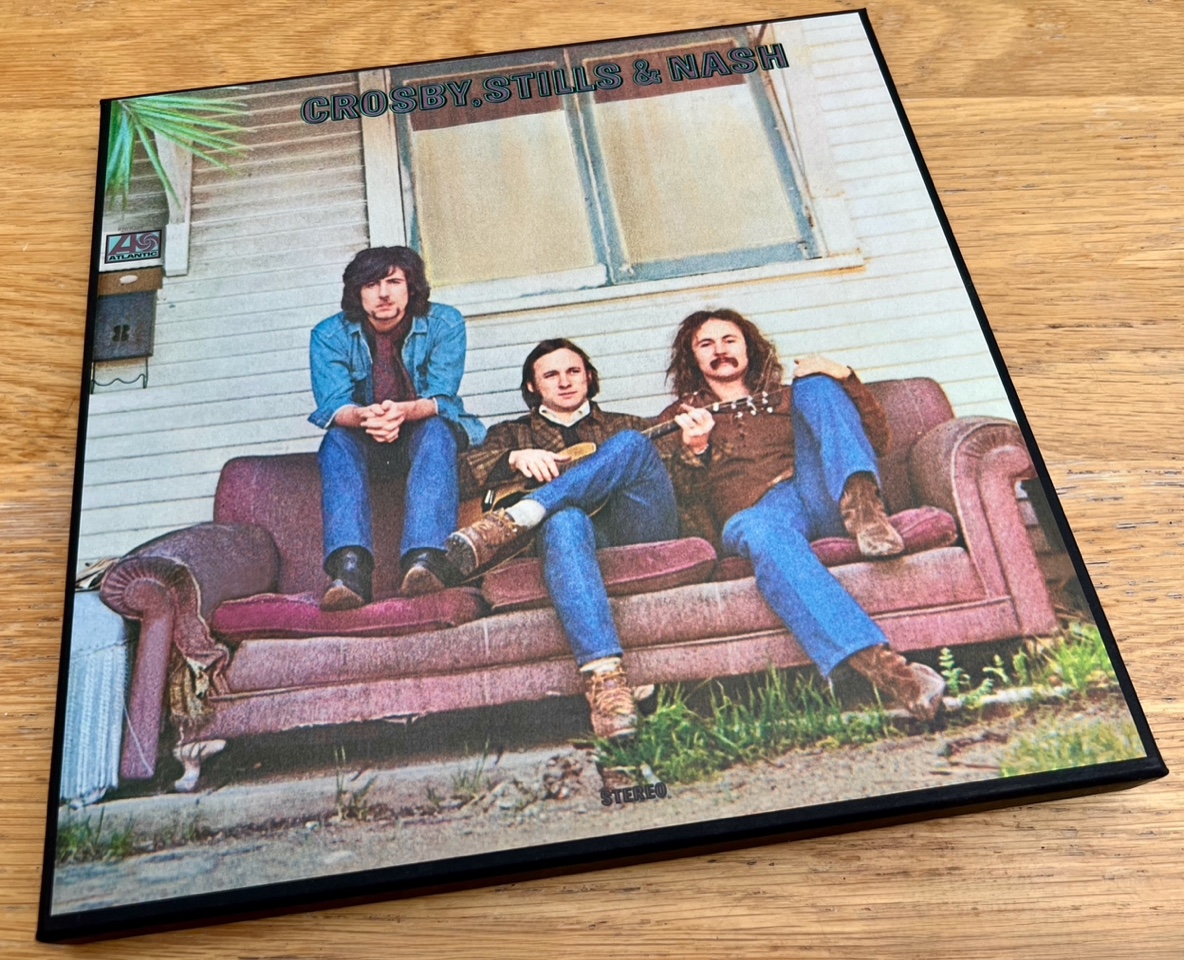
The music so relaxed, pure, the playing and technique involved so significantly music friendly and the feeling of the old textured record sleeve made me to think about the great records which came with this "ol'England" feature... came to mind Bryter Layter by Nick Drake, Bert Jansch's Rosemary Lane, Sky in my Pie by John James and Pete Berryman, CSN & Y - Deja Vu, Neil Young - Harvest, Sandy Denny - Sandy and Old Fashioned Waltz, John James' 2nd and John Renbourn's The Hermit (first pressing only), both on Transatlantic ... sure others exist... will possibly add in the near future.

Really the '70s were special: the care for details, recording, the slowest life pace all are romantically still "here" only handling these canvas-like textured records covers... try this with your cheapos, penny-pincher downloads;-)))

It's a very definite feeling... something similar happens when I play one of my old, 60+ years old acoustic guitars... can't stop thinking about who played in the decades, where they lived, the travels, the haulings, like if these inanimate things would be able to share with me their experiences.

Gestalt;-)

Friday, August 14, 2009

Davey Graham: an important BBC 4's hommage to the great musician


Folk Britannia, with rare footages

Where the Hell is Matt?


A loving, no-brainer, poetic, dadaist, peaceful, universal brotherhood act...

I love him!

Where the Hell is Matt? video

Thanks to Pierre Bensusan for hinting it.

Dave Evans... acoustic guitar player extraordinaire


One of my true acoustic guitar heroes has been - for decades now and much more than John Renbourn or Leo Kottke, on same Bert Jansch and John Fahey and Robbie Basho's pars - the great, now (musically) "semi-retired" Dave Evans.

As not too much has been recently written about him - on paper and web, as well - let me try to fill the gap, as he wrote, arranged and played among the most pleasant, beautiful, challenging, poetic - to play and to listen to - guitar tunes, ever.

As a plus, he represented, to me, the Renaissance/African bridge with modern times, as he built his first self, hand made acoustic green-topped guitar in 1968 and recorded the seminal first two much sought-after records ("The Words in Between" and "Elephantasia", items which you'll not easily see at your local second-hand disc shop) - Ian A. Anderson's produced, published on his The Village Thing label, and two of the (almost) three records he made for Ed Denson/Stefan Grossman's Kicking Mule Records.

Like a kora player from Mali, he first built his instruments, that green guitar, then the sharp edged one, shown on "Take a bit out of life" disc cover and he played his own composed tunes flawlessly on them... if you look at the rare YouTube footage (see here below...) from the early '70s, titled "Stagefright", you'll appreciate the relaxed fluency, the elegant, yet minimalist fingering and right hand technique, something which, beside the musical, instrumental dexterity per se, is only achieved through an intimate knowledge of the instrument he built himself.

With its 12 frets out of the body, large fingerboard, very personal sonic footprint, it's like a voice: unique.

All his tunes, from Sad Pig Dance to The Whistling Milkman used quite weird, seldom seen tuning, being variation/mixes of C and G tunings, with merits of both: by chance, his CGDGAD became one of my (humbly) fave, like Michael Hedges' and, most of all, Alex de Grassi's.

But the highest peaks of Dave Evans's art were reached with the five Irish tunes he arranged and played on the last recordings he made: Irish Reels, Jigs, Hornpipes and Airs on Kicking Mule label.

He shared this very disc with Davey Graham, Duck Baker and Dan Ar Bras, BUT Dave's tunes shine of a sooo bright light to shadow other, no lesser tunes.

His playing is so easy to the ears that when I had the chance, some years after this disc was issued - thanks to Janet Smith from Berkeley, California for sending to me all the TABs... also if we corresponded for years, she will never know what a turbo gift she made to me;-)) - while learning and playing these tunes, I fully appreciated the class, the beauty of these melodies and arrangements: The Galtee Hunt, Sheebeg and Sheemore, The Donegal Pilgrim, Mawgan Magan and Hewlett are in my playing playlist since early '90s... and every time I play I smile like an idiot, so satisfied to look at my fingers dancing up and down the fretboard!

It's possibly a less-flashy, yet purer, acoustic guitar playing than, say, the Don Ross', Michael Hedges' hinted or Tommy Emmanuel's approaches, with tapping and the likes... BUT when, at every guitar gathering or Open Mike wherever you play one of these... well, folks... people get trapped in awe... it's a mix of old melodies, weird, unseen technique and tunings and a touch of mistery (i.e. - "Dave Evans? Who's him? Do you mean AC/DC's singer?!?! Uhhh... he's also playing nice acoustic guitar..." or "Do you mean The Edge, U2 guitarist?!?! Great!"

... the names confusion didn't help, indeed!

After building an harp guitar for Pierre Bensusan, who still honours Dave on his nice site for this masterpiece, mr. Evans, now David Evans, settled in Belgium many years ago, where he managed another of his passions: pottery.

While sharing with mates a traditional brewery, he still persues pottery, with occasional guitar fixing on demand and, I hope'n'trust, some guitar playing.

A very Renaissance-like man, with beauty and good life as a goal... he will always remain an hero and a lighthouse for me.

Thanks a lot, Dave... hope to meet you in the near future, David;-)

Dave Evans' "Stagefright" on YouTube

La Touffe Brewery and Pottery

Dave Evans in Pierre Bensusan's site, about his harp guitar


Thursday, August 13, 2009

Guitar legend-inventor Les Paul dies at age 94


Guitar legend-inventor Les Paul dies at age 94
By LUKE SHERIDAN (Associated Press Writer)
From Associated Press
August 13, 2009 2:14 PM EDT

WHITE PLAINS, N.Y. - Les Paul, who invented the solid-body electric guitar later wielded by a legion of rock 'n' roll greats, died Thursday of complications from pneumonia. He was 94.

According to Gibson Guitar, Paul died at White Plains Hospital. His family and friends were by his side.

As an inventor, Paul also helped bring about the rise of rock 'n' roll with multitrack recording, which enables artists to record different instruments at different times, sing harmony with themselves, and then carefully balance the tracks in the finished recording.

The use of electric guitar gained popularity in the mid-to-late 1940s, and then exploded with the advent of rock in the mid-'50s.

"Suddenly, it was recognized that power was a very important part of music," Paul once said. "To have the dynamics, to have the way of expressing yourself beyond the normal limits of an unamplified instrument, was incredible. Today a guy wouldn't think of singing a song on a stage without a microphone and a sound system."

"Without Les Paul, we would not have rock and roll as we know it," said Terry Stewart, president of the Rock and Roll Hall of Fame and Museum. "His inventions created the infrastructure for the music and his playing style will ripple through generations. He was truly an architect of rock and roll."

A tinkerer and musician since childhood, he experimented with guitar amplification for years before coming up in 1941 with what he called "The Log," a four-by-four piece of wood strung with steel strings.

"I went into a nightclub and played it. Of course, everybody had me labeled as a nut." He later put the wooden wings onto the body to give it a tradition guitar shape.

In 1952, Gibson Guitars began production on the Les Paul guitar.

Pete Townshend of the Who, Steve Howe of Yes, jazz great Al DiMeola and Led Zeppelin's Jimmy Page all made the Gibson Les Paul their trademark six-string.

Over the years, the Les Paul series has become one of the most widely used guitars in the music industry. In 2005, Christie's auction house sold a 1955 Gibson Les Paul for $45,600.

Guitarist Joe Satriani called Paul "the original guitar hero," saying: "Les Paul set a standard for musicianship and innovation that remains unsurpassed."

In the late 1960s, Paul retired from music to concentrate on his inventions. His interest in country music was rekindled in the mid-'70s and he teamed up with Chet Atkins for two albums. The duo were awarded a Grammy for best country instrumental performance of 1976 for their "Chester and Lester" album.

With Mary Ford, his wife from 1949 to 1962, he earned 36 gold records for hits including "Vaya Con Dios" and "How High the Moon," which both hit No. 1. Many of their songs used overdubbing techniques that Paul had helped develop.

"I could take my Mary and make her three, six, nine, 12, as many voices as I wished," he recalled. "This is quite an asset." The overdubbing technique was highly influential on later recording artists such as the Carpenters.

Released in 2005, "Les Paul & Friends: American Made, World Played" was his first album of new material since those 1970s recordings. Among those playing with him: Peter Frampton, Jeff Beck, Eric Clapton and Richie Sambora.

"They're not only my friends, but they're great players," Paul told The Associated Press. "I never stop being amazed by all the different ways of playing the guitar and making it deliver a message."

Two cuts from the album won Grammys, "Caravan" for best pop instrumental performance and "69 Freedom Special" for best rock instrumental performance. (He had also been awarded a technical Grammy in 2001.)

Paul was inducted into the National Inventors Hall of Fame in 2005.

Paul was born Lester William Polfus, in Waukseha, Wis., on June 9, 1915. He began his career as a musician, billing himself as Red Hot Red or Rhubarb Red. He toured with the popular Chicago band Rube Tronson and His Texas Cowboys and led the house band on WJJD radio in Chicago.

In the mid-1930s he joined Fred Waring's Pennsylvanians and soon moved to New York to form the Les Paul Trio, with Jim Atkins and bassist Ernie Newton.

Meanwhile, he had made his first attempt at audio amplification at age 13. Unhappy with the amount of volume produced by his acoustic guitar, Paul tried placing a telephone receiver under the strings. Although this worked to some extent, only two strings were amplified and the volume level was still too low.

By placing a phonograph needle in the guitar, all six strings were amplified, which proved to be much louder. Paul was playing a working prototype of the electric guitar in 1929.

His work on taping techniques began in the years after World War II, when Bing Crosby gave him a tape recorder. Drawing on his earlier experimentation with his homemade record-cutting machines, Paul added an additional playback head to the recorder. The result was a delayed effect that became known as tape echo.

Tape echo gave the recording a more "live" feel and enabled the user to simulate different playing environments.

Paul's next "crazy idea" was to stack together eight mono tape machines and send their outputs to one piece of tape, stacking the recording heads on top of each other. The resulting machine served as the forerunner to today's multitrack recorders.

In 1954, Paul commissioned Ampex to build the first eight-track tape recorder, later known as "Sel-Sync," in which a recording head could simultaneously record a new track and play back previous ones.

He had met Ford, then known as Colleen Summers, in the 1940s while working as a studio musician in Los Angeles. For seven years in the 1950s, Paul and Ford broadcast a TV show from their home in Mahwah, N.J. Ford died in 1977, 15 years after they divorced.

In recent years, even after his illness in early 2006, Paul played Monday nights at New York night spots. Such stars as Led Zeppelin's Jimmy Page, Dire Straits' Mark Knopfler, Bruce Springsteen and Eddie Van Halen came to pay tribute and sit in with him.

"It's where we were the happiest, in a `joint,'" he said in a 2000 interview with the AP. "It was not being on top. The fun was getting there, not staying there - that's hard work."

(Thanks to Luke Sheridan for copy & paste of his text...)

Wednesday, August 12, 2009

WJAAS - The Elusive Mount Fuji


At less than 20 days from my Japan trip... will I be able to see the elusive Mount Fuji, when in Tokyoo-shi?

The apparently silly question isn't so silly... fog, clouds, the lights glare of the metropolis... the 90 percent humidity... all will be my enemies to enjoy the Mighty Mountain's view.

This 24/24-7/7-365/365 webcam will help to check the situation, at least;-)

Mount Fuji's live webcam

Tuesday, August 11, 2009

Self taught oud


I really, mean REALLY suffer from not having a flesh & bone tutor but the WEB in my oud path, folks!

Sure Mike's Oud and the several links available on YouTube help - i.e. looking at great and lesser players (all so vastly superior to my playing I'm someway embarassed...) looking at their reesha strokes, tremolo, absorbing some traditional melodies, etc. World would be a worst place without these links and support...

Yesterday evening I placed myself and my oud in front of my music system and began dueting with an old, great santur and percussion, disc: Djalal Akhbari - The Art of Persian Santur on Arion... something I didn't since my boyhood, when I learned guitar from Led Zeppelin or Jethro Tull's discs.

Must say that trying to improvise on the notes, better, following the skillfull hands and melodies of the master musician was almost impossible, at first.

After some minutes I sort of entered in the magic of maestro Akhbari... was able to find some patterns on my oud.

The fingering to obtain such a melodies surprised me, but I continued for the whole record side, preferring, of course, being the beginner I am, the quieter moments instead of the most intricate.

The reason I'm posting such a quite common topic and content is that, to my surprise, this morning I picked up my oud before going to work and... WOW, the melody I (badly) fingered yesterday was carved in my memory and, WOWOW... my fingers remembered it.

I guess must go to Damascus for some oud lessons... but in the meantime, will repeat the above with other Arabic music records I have in my discs shelves.

Wednesday, August 5, 2009

... yes: I'm omnivorous, shamelessly omnivorous...


Sure someone will blame me for this, maybe my music pusher, Ivan, for first, BUT... who cares... I feel me so nicely vibrating when some music - from weird to forgotten, to old, missed records to new, freshly brewed - captures my deepest attention, plucking my most inner strings blissfully.

So, after I tried to "justify" my fearless musical tastes... enters Lars Horntveth's "Pooka" from Norway...

It's Jaga Jazzist's leader debut... Ivan gave to me when I asked for something "new" and seldom heard... well, folks: it's a 2003 disk, so it's only new for me... sure it's a VERY strange disc... very north european, I'd say (but with a sunny, yet burnished sad character)... it's some Penguin Cafè Orchestra, and Grieg, and British '70s orchestral jazz (with some echoes of my beloved The Chitinous Ensemble and of Mike Westbrook's compositions), it's mysterious, poetic, smooth acoustic X-music, an hinted electro-pop with classy Gil Evans-esque strings arrangement (always Horntveth's).

The understated 2-colours cover isn't giving justice to the music colours in the disk itself... it's an underground soundtrack-like, impressionistc effort...

... and I love it!

Friday, July 31, 2009

Robert Wyatt at RAI - Radio 3 Studio - Rome in February 1981


The cycle is completed, folks... RAI Trade/Radio 3, the italian national broadcasting radio, finally published as "Robert Wyatt - Radio experiments February 1981", the long awaited, fabled complete sessions Robert Wyatt recorded during a week of free composing, playing and recording in labs-like conditions.
The idea was to try to aurally "show" the process behind the artist, like when Picasso was asked to paint behind a glass... Robert Wyatt, being the great artist, 100 percent intellectually honest with himself AND listeners, deliberately avoided playing with producers who invited him in Rome, almost 27 years ago - i.e. playing something which was already in semi-finished form... he wanted to accept the match and try the hard way, with new-from-scratch ideas and never heard solutions, like jew-harp loops and vocal multi-recording unheard since "Moon in June" or "Las Vegas Tango".

The tracks-list is the following: 1. Opium War - 2. Heathens Have No Souls - 3. L'albero degli zoccoli - 4. Holy War - 5. Revolution Without "R" - 6. Billie's Bounce - 7. Born Again Cretin - 8. Prove sparse

The recording quality is awesome, in full AAD glory and some passage, like in "L'albero degli Zoccoli", reminds and it's echoing an embryonic "Rock Bottom"... like if the 1974 disc music remained in debrises in Wyatt's brain... but every piece is like brand new music for Third Millenium.

I personally find a very illuminating listening what an humble jew-harp is capable in Robert Wyatt's hands... and this voice!

This very disc represents a sure, personal "Top of the Pops 2009"... and definitely well worth a passionate listening by everyone.

Thursday, July 30, 2009

The art of browsing


Yesterday evening, while listening to some FM radio before sleeping, I considered the following: as I found a nice radio station playing superb '70s Progressive music, the utmost pleasure in listening in the dark to some music you didn't choose, BUT which someone else made for you, enhances greatly the enjoyment... sort-of like the DJ out in the blue cocooned you and every listener with attention and loving choices.

This reminds me that, possibly, men of every age love being surprised, let's call it "the gift syndrome";-))) - i.e. it's much more intriguing and pleasant finding a sought-after disc at a second-hand shop, in some dusty bin, instead of paying top bucks on Ebay or GEMM, don't you?

... but it's not only about the fact of money saving... it's the accelerated heartbeat, the sweaty, feverish eyes wide shut-mode you experience when holding the just found, cherished item in yr. hands, for a long, orgasm-like moment.

Yes, it's the collector speaking... but "the gift syndrome", this pleasant sense of humble astonishment, is also here when I listen to my trusty, old iPod Shuffle... I also own the larger, high-tech 8GB model... BUT the FM-like, don't-know-what's-behind-the-corner of the cheap little gizmo is always surprising and zesty to my ears, never annoying or boring.

Men: strange breed we are...

Wednesday, July 29, 2009

The oud - a God friendly instrument which touches everyone soul


My already strong interest in oud and, to a broader extent, arabic/eastern music reaches, these days, its peak.

Dimitris Rapakosius, the fine luthier from Athens, finally completed the rebuilt/overhauling of my old Moroccan oud and shipped it to me few hours ago
(cannot stay in my shoes waiting to play it again), and my Salman Shukur, Youssuf Dhafer, Rabih Abou Khalil and Anouar Brahem's listening sessions are always very satisfying, sort-of "it's the music I need right now".

What pushed me to humbly write on this very topic is that in Mike's Oud site appeared an oud musical compendium seldom heard everywhere, a very specialized playlist compiled with care and dedication.

Have a listen... if someway unaware of the beauty and glory of this music, you could be shocked, indeed!

Mike's Oud Playlist

Farid el-Atrache's Oud

Niza Rohana's Oud

Other rare oud performances

Thursday, July 23, 2009

Nicker Hill Orchestra - "All the different deaths... and rebirths" or always trust in chance...


... as things happens, folks... yesterday evening, while under the fan in a midsummer hot & wet night, I tuned for some pre-sleeping soundtrack from my B & O red radio... some chatting, some disco, some... oh, oh... Music?!?!

Was captured by a local radio, and I immediately stopped my tuning fingers and my attention to the notes of some worth, seldom heard music these days from FM radio waves... who's playing? A new Sigur Ros'? Maybe Opeth, with some "Damnation" outakes? ... again: the new Mogway?

After a couple of tracks from the radio I understood the group was "Nicker Hill Orchestra" with their last, second instrumental-only effort titled "All the different deaths... and rebirths".

What can I say?!? It's great, fresh, proud, lovingly played music from a group coming from Northern Italy, between Padua, Rovigo and Modena... Mattia and his pals made something, in my humble opinion...

I ordered their disk today, of course... you'd better go to give a chance to these musicians and to their Orchestra... they sound so embarassingly new, as they sound classic enough to fool an old S.O.B like yours truly... not bad for a new group.