Search this Blog

Pageviews

Monday, November 13, 2023

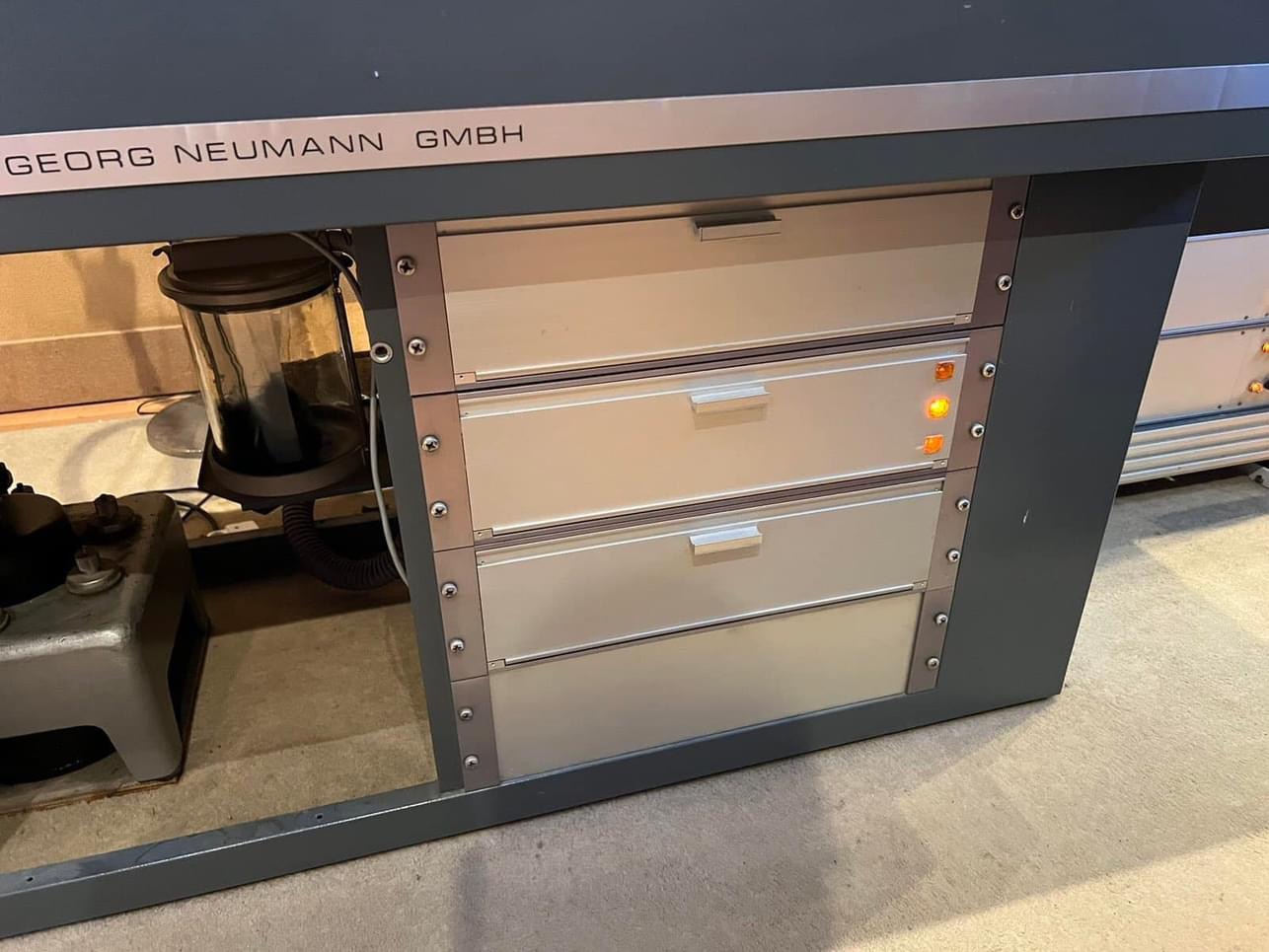
A gorgeous Neumann VMS-70 disk-mastering lathe for sale


From Jesus Agnew/Agnew Analog:


Neumann VMS70 disk mastering lathe up for sale, with a Neumann SX74 cutter head, Neumann SAL74B cutting amplifier rack, Neumann SP272 transfer console (complete with iconic Neumann ashtray), Dolby A units (Model 360), cutting DDL and a few other extras. 


Lyrec motor, original Neumann pitch/depth automation system.


Fully functional, can be seen in action. I have personally worked on this machine at Agnew Analog. Training on its use and maintenance can be provided, if required.


Available immediately. Reasonable price. International shipping is no problem. Crating is possible. Currently located in Greece, Europe. Assistance with setting up at your premises can be provided, if required, anywhere in the world. 


This is a complete system, ready to cut. Configured for 230 VAC/50 Hz, but can be reconfigured for 115 VAC/60 Hz if required.


Please contact us by email for further information: info at agnewanalog dot com


I wish I had room enough in my tiny studietto 😏


Saturday, November 11, 2023

Vinyl Walhalla 😳


The only limit is our bank-account balance… 😏


… and how many IKEA’s Kallax we own 

😎


Derek Bailey and Paul Motian “Duo in Concert”


With their first new release since 2017, the venerable Frozen Reeds returns with “Duo in Concert” an absolute gem of archival free improvisation, recorded in 1990 by the unexpected and short-lived collaboration of Derek Bailey and Paul Motian

Recently discovered in the archives of Bailey’s Incus Records and fully mastered by Jim O’Rourke, this beautiful LP captures one of two known recorded documents of these two seminal players (the other being included as free digital download with this release).

With each venturing into uncharted waters that defy the expectations of their respective playing styles, it is a towering document of the power and possibility of free improvisation that can’t be missed.


Derek Bailey, Paul Motian
Duo in Concert

(LP)


Since its founding in 2012, the Helsinki-based imprint Frozen Reeds has redefined the notion of glacial pace, issuing only five releases between then and 2023. Despite the relative sparseness of their discography, Frozen Reeds’ output - most notably their historic editions of Julius Eastman’s “Femenine” in 2016 and Roland Kayn’s “A Little Electronic Milky Way of Sound” in 2017 - has occupied such a high bar of quality and importance that the imprint has remained a constant fixture in our minds. Their latest, “Duo in Concert” - an astounding archival recording by Derek Bailey and Paul Motian - rises to this incredible standard and more. Recently discovered in the archives of Bailey’s Incus Records, this beautifully produced LP captures these two luminaries in the history of jazz and improvised music at Groningen’s JazzMarathon festival in the Netherlands, in the midst of a brief period when they came together in collaboration during the early '90s. Creatively stunning and historically significant - revealing previously unknown dimensions of both players - in addition to the contents of the vinyl LP, fully mastered by Jim O’Rourke, “Duo in Concert” also includes a free download of the only other known concert of the pair at New Music Cafe in New York City in 1991, as well as newly commissioned liner notes by Bill Frisell and Henry Kaiser. Frozen Reeds is back with force and doesn’t disappoint.


In the history of free improvised music, there has been arguably no greater advocate for the idiom’s power and potential than the English guitarist Derek Bailey. Fiercely principled, between his emergence during the 1960s and his death in 2005, he cut a wide path, positioning this music as the height of creativity, transpiring in real time, and a means through which people from diverse backgrounds could come together, express, and commune. For Bailey, “playing is about playing with other people... improvisation is a process that gets relationships sorted out”, and this was something that best transpired in a live context.


In this light, Bailey’s slightly unexpected convergence with the drummer Paul Motian takes on a particularly fascinating dimension, indicating the openness of both artists in their creative and collaborative choices. Initially becoming famed as the drummer in the pianist Bill Evan’s legendary trio alongside Scott LaFaro, despite his relatively straight ahead foundations, during the '60s and '70s he would diverge widely, playing with Paul BleyKeith Jarrett, in Charlie Haden’s Liberation Music Orchestra, and Don Cherry, among others, before venturing out on his own as a leader, flirting around the edges of the diverse possibilities presented by the avant garde.


While many of Motian’s more forward-thinking collaborative partnerships endured through the '80s and beyond, during the years prior to the drummer’s meetings with Derek Bailey, his temperaments of output had largely mellowed across a number of LPs for Soul Note and ECM. Coming together for two shows - the first on the 7th of December, 1990, at JazzMarathon in Groningen, the Netherlands, and the second the following year at New Music Cafe in New York City - each stand among the rare recorded documents of Motian as a free improviser. 


Captured across the two sides of Frozen Reeds’ release, “Duo in Concert”, both Derek Bailey and Paul Motian bring their respective decades of experience at the forefront of jazz and free improvisation to deliver some of the most vital playing in the careers of either. As Bill Frisell states in the album’s liner notes: “This is one of those moments that we’re always hoping for, and it's so rare. And it's so hard to talk about, because it's so beautiful. It's like you're seeing some new species of plant that you never knew existed or something.

Perhaps most striking, because of the relative rarity of an encounter with his playing on these terms, is Motian’s mastery of free improvisation. Fierce and forthright, he lays down a palette of pulsing textures - often taking on repetitive cycles that almost imply song-like structures - against Bailey’s non-idiomatic jabs of tone and passages that border on the melodic, that undermine long standing perceptions about his playing and contrarian antagonism, and allow for a more gradual introduction of note and timbre than was typical of his playing during this period. Often riding a knife’s edge, the two players dance and dart against the other’s interventions, each delivering startling changes in dynamics, preciousness, and tone, culminating as some of the most striking, unexpected, and singular playing of either’s careers.


Compelling, balanced, and thrillingly paced, Bailey and Motian’s “Duo in Concert” is a joy to hear, taking great leaps toward revealing the further possibilities opened by the practice of free improvisation. Frozen Reeds has done it again with yet another release of towering historical importance. Issued as a beautiful vinyl LP - fully mastered by Jim O’Rourke - “Duo in Concert” also includes a free download of the only other known concert of the pair at New Music Cafe in New York City in 1991, as well as newly commissioned liner notes by Bill Frisell and Henry Kaiser. Amazing and not to be missed.

Friday, November 10, 2023

Life?


Thelonious Monk playing table-tennis


Kraftwerk & MCI multi-track reel to reel machine


I suspected beloved Kraftwerk were using some German tape-machines - i.e. Telefunken - in their Kling Klang Studio… I was wrong as this picture shows an U.S. made MCI’s (mounted in heavy-duty aluminum flight case… and - 😎 - a Swiss-made STUDER’s mixer.


The Masters 🥇


Thursday, November 9, 2023

TEE - Trans Europa Express


Kraftwerk’s fascination for trains was my youth fascination, too.


The speed, the beauty of shapes and functions, the dream of traveling.


I recently re-rediscovered Kraftwerk’s music after a decades-long hiatus: they have been true geniuses.

🔝


Wednesday, November 8, 2023

Led Zeppelin IV - the cover secret unveiled


The man depicted on the cover of Led Zeppelin's 'IV' album has been revealed as a 19th century thatched roof builder.The portrait is most likely that of Lot Long of Mere in Wiltshire, photographed by Ernest Farmer.


As the BBC reports Brian Edwards, of the University of West England (UWE), found the original photo while searching through an album of photographs for further research." I immediately recognized the man with the sticks - he's often called that," he said.


The Wiltshire Museum has acquired the photograph and plans to include it in an exhibition next year.


Released in 1971, Led Zeppelin 'IV' has sold more than 37 million copies worldwide and includes the big hit 'Stairway to Heaven'.


A historic fan of British rock band Led Zeppelin, told BBC Radio Wiltshire 'it was a real revelation'. The cover had previously been described as a photograph of a painting, which had been discovered by the band's lead singer, Robert Plant, in an antique shop near guitarist Jimmy Page's home in Berkshire.


But the framed image of the man with sticks on his back that you can see on the cover is actually a colorful photograph that you don't know where he is yet, the one that was discovered is the original black and white photo.


Brian Edwards – who is part of the regional history centre at the UWE in Bristol – explained how he found out that the original photographer was Ernest Farmer, who died in 1944. The only clue in the photo album was the name of photographer Ernest, but Edwards discovered hundreds of Victorian photographers with that name.


She said the quality of the photos suggested that they were taken by a professional, and so she looked at pharmacies, as many of them were involved in photographic production.


Edwards thus discovered a chemist who worked in Salisbury, near where the photo was taken, who had a son named Ernest Farmer, and then found his handwriting online. Farmer was the first director of the school of photography at the then newly renamed Regent Street Polytechnic, now the University of Westminster.


“Part of the signatures correspond to some spellings of the photo album,” he said. “The black and white photograph has a thumb imprint in the corner and it looks like it's the original,” Edwards added.


The photo album contains mainly views and architecture from South Wiltshire and Dorset has a dedication and is titled “Reminiscences of a Visit to Shaftesbury. Pentecost 1892. A gift to Aunt Ernest's.”


Brian Edwards then began researching the haystacks of that period and said his research suggested that the man depicted was Lot Long, who died in 1893 and who was building thatched roofs for houses at the time.


The director of the Wiltshire Museum, David Dawson, has announced that the exhibition in the spring of next year, where the photograph will be exhibited, will be titled 'The Wiltshire Thatcher: a Photographic Journey through Victorian Wessex, and will celebrate the work of Ernest Farmer'. “We're going to show how Farmer captured the spirit of the people, villages and landscapes of Wiltshire and Dorset that were so at odds with his life in London.


“It's fascinating — Dawson added — to see how this theme of rural and urban contrasts was developed by Led Zeppelin and became the centerpiece of this iconic album cover 70 years later”


Monday, November 6, 2023

Rudy Van Gelder


Rudy Van Gelder started recording artists such as Miles Davis and Cannonball Adderley in the early 50s, in the comfort of his parent’s living room. It wasn't until 1959 that he opened his studio in Englewood Cliffs and along with Alfred Lion, changed the way Jazz was being recorded. In his six-decade career, it is estimated that he has recorded, mixed, and mastered over 2000 albums not only for Blue Note but Verve Records, Impulse!, CTI, and many others.


Blue Note Records founder Alfred Lion and Van Gelder first met when musician Gil Melle introduced them in 1953. Lion was impressed with the sonic clarity of Van Gelder's recordings, and he made sure that Van Gelder recorded most Blue Note sessions from 1953 to 1967. The signature “Blue Note Sound” is really a culmination of Lion's devotion to hard bop jazz, Van Gelder's meticulous pursuit of accurately capturing that improvisatory music, and the remarkable playing of the musicians on those early sessions at the Hackensack home studio. In his later career, Van Gelder operated from his state-of-the-art digital facility in Englewood Cliffs, N.J., where he worked with re-issue producer Michael Cuscuna on the RVG Series.


Van Gelder started recording musicians in his parent's living room in Hackensack as a hobby. Overwhelming demand from musicians and producers forced him to quit his day job as an optometrist and record music full-time. Before he started making his own records, Van Gelder simply wanted to re-create the audio experience of live music, his love for jazz and hearing it played back accurately led him to audiophile equipment stores.


“When I first started, I was interested in improving the quality of the playback equipment I had,” Van Gelder explains. “I never was really happy with what I heard. I always assumed the records made by the big companies sounded better than what I could reproduce. So that's how I got interested in the process. I acquired everything I could to play back audio: speakers, turntables, amplifiers.“When I started making records, there was no quality recording equipment available to me,” he continues. “I had to build my own mixer."


Van Gelder was also an enthusiastic supporter of digital audio and an avid learner of new gear and software. “I believe today's equipment is fantastic,” he says. “I wouldn't want to face a session without the editing capabilities of digital. There are still maintenance and reliability issues. Tech support helps. From my viewpoint, the essential difference between analog and digital is that analog does not like to be copied,” Van Gelder continues. “After the original is recorded, edited, and mixed, then what? You need a digital delivery medium. In that sense, the final product can be much higher quality than in the '70s.”


Despite his considerable reputation in the jazz world, Mr. Van Gelder deflected any credit for the sounds he recorded over the decades. He said that praise should go to the musicians, and to the producers who hire and direct them.


In the final analysis of Rudy Van Gelder, he established the standard for sonic excellence on par with that of the many great and legendary musicians he recorded over the decades. He has certainly done that and it's a legacy that Blue Note is preserving. The label has established "The Rudy Van Gelder Series," which consists of more than 200 classic Blue Note albums remastered by him. And Blue Note recently released "Blue Note Perfect Takes," a collection of essential tracks that Mr. Van Gelder picked for their sonic and musical excellence; the collection also includes an interview with him on DVD.


Source: All About Jazz: thanks 🙏


Golden Rule


His Bobness’ beginnings


Wednesday, November 1, 2023

Neil Young and Rick Rubin…


… talking about analog recording and composing while walking in the wild near his Barn 🎼


🥇